
Infinity Insights - Volume 16, Volume 2
MONTHLY UPDATE - FEBRUARY 2026 EDITION
NATURAL GAS
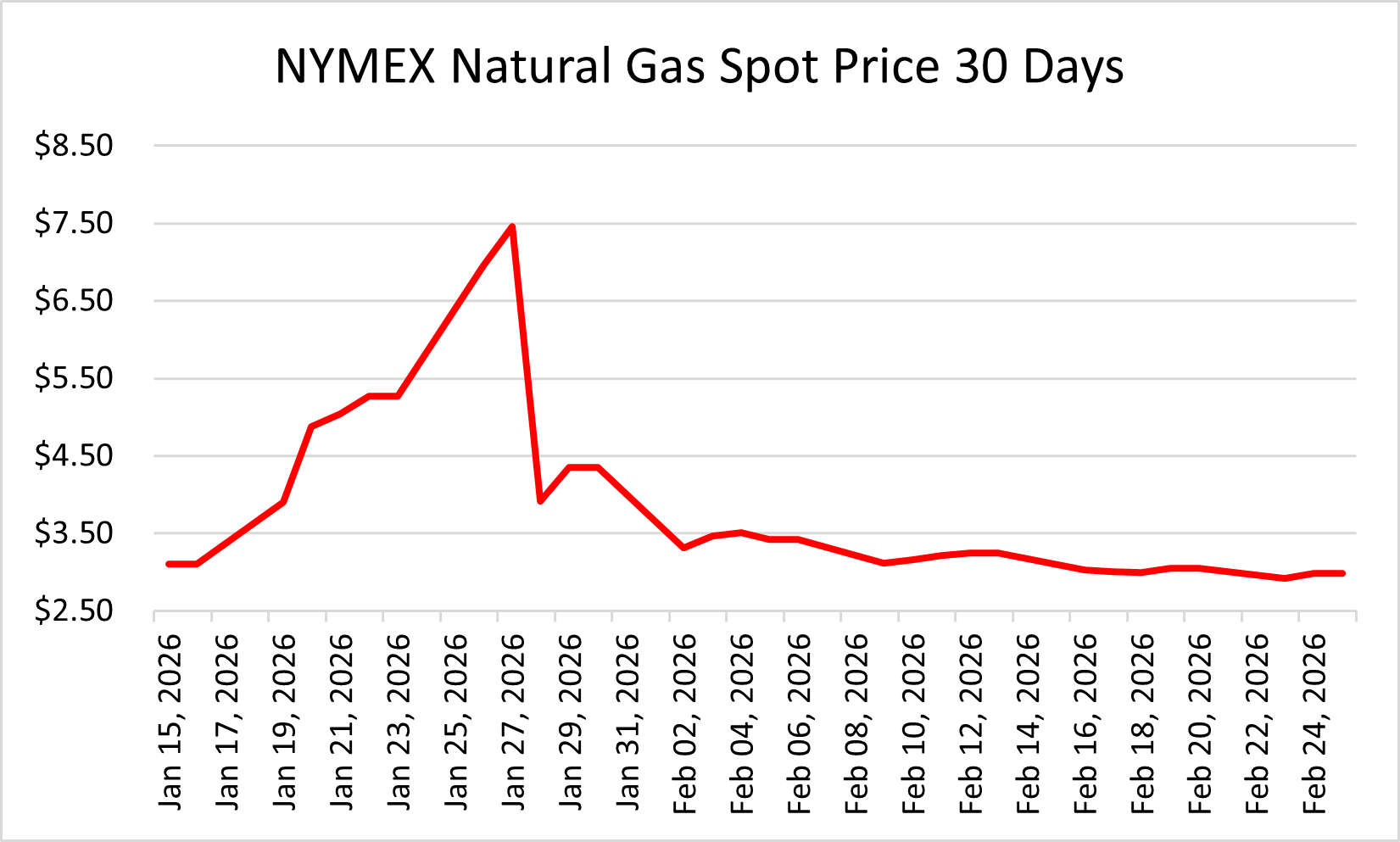
Spot NYMEX Natural Gas fell drastically with the passing of Winter Storm Fern. Fern did not develop into as severe of a storm as some speculators anticipated. Considering the time of year, with the bulk of winter risk behind us, natural gas prices quickly retreated and have held steady at <$3.50.
Winter Storm Fern caused a historical draw in underground natural gas storage. Week ending 1/30/26 flipped inventories the prior week from a 5.3% surplus to the 5-yr average to a -1.1% deficit to the 5-yr average. Along with high usage, Fern caused production freeze-offs to the extent it is estimated January ’26 production fell 3% versus December ’25.
EIA’s Short-Term Energy Outlook is forecasting Henry Hub to average $4.30/MMBtu and $4.40/MMBtu in ’26 and ’27, respectively. EIA’s prior release estimated $3.50/MMBtu for ’26. The forecast was adjusted based on the massive winter draws. If these prices are realized we expect producers will be incentivized to accelerate production.
Spot natural gas has support at $2.50 with resistance at $3.00.
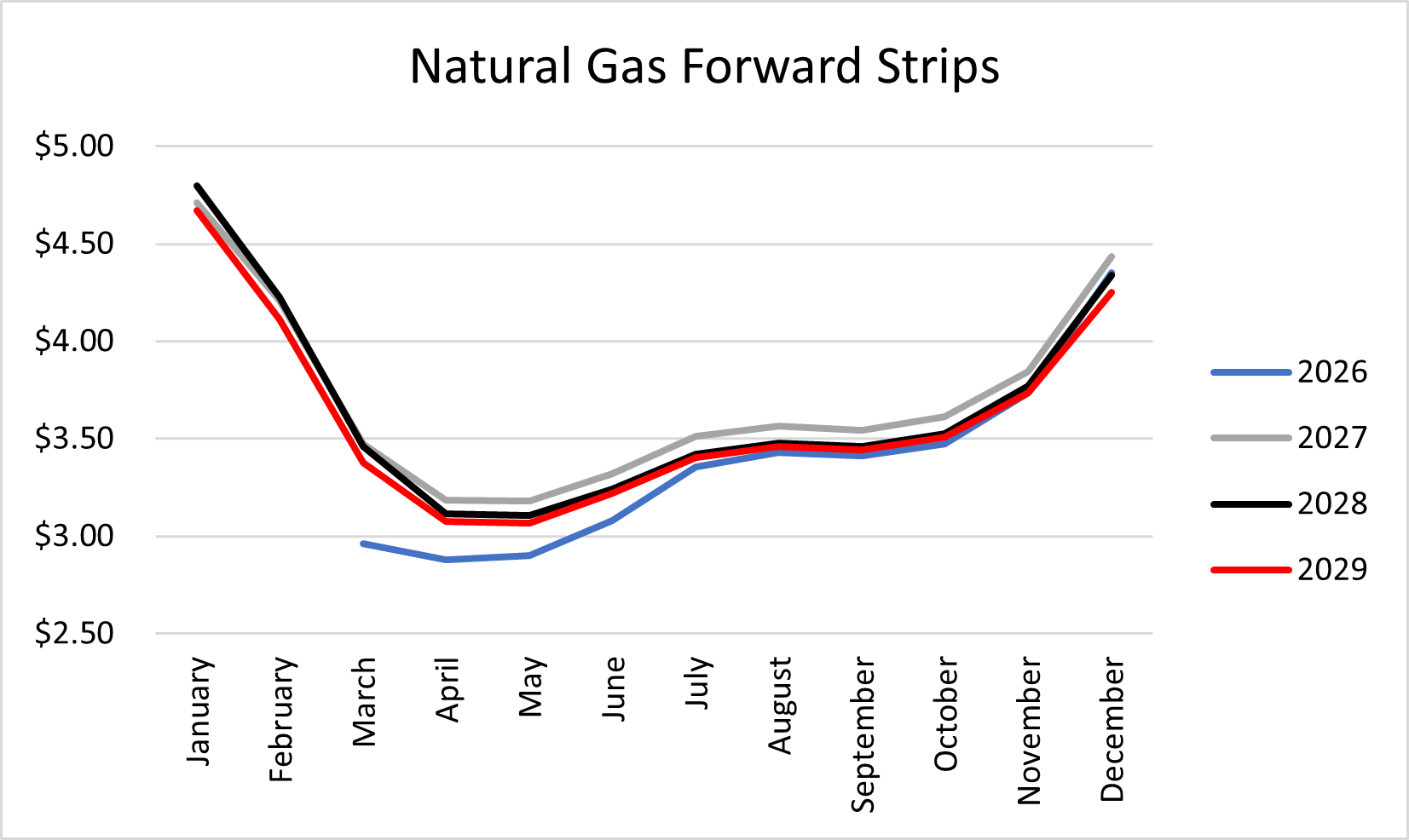
Balance year 2026 finds support at $2.88 with resistance at $4.35. Calendar year 2027 has support at $3.18 with resistance at $4.71. Calendar year 2028 has support at $3.10 with resistance at $4.48 – these future strips are essentially in line with our last publication. These numbers are based on wholesale future contract price action, which somewhat contradicts the EIA’s forecast suggesting Henry Hub will average $4.30/MMBtu in ‘26.
Global natural gas prices ($/MMBtu):
Henry Hub (USA): $2.84↓
NBP (UK): $10.03↓
TTF (Dutch) $9.75↑
JKM (Japan/Korea) $10.52↑
Weather
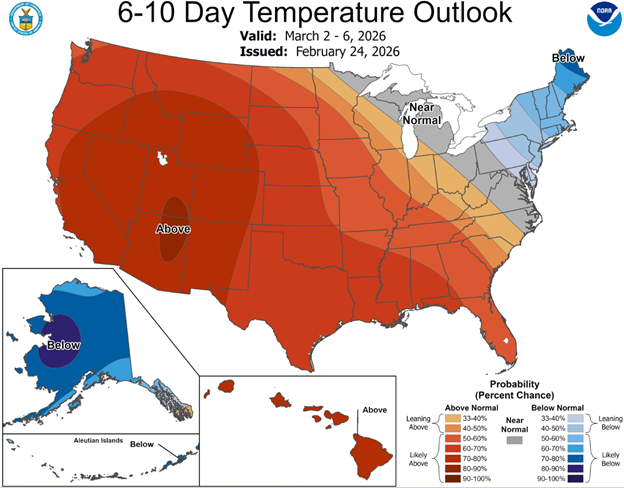
The 6-10 Day and 8-14 Day Temperature Outlook show above normal temperatures for the vast majority of the lower-48, with some slightly cooler than normal temperatures in the Northeast in the short-term.
Looking back at January ‘26, on a population-weighted basis, the US temperature was in line with the historical mean. December ‘25 heating degree days came in low at -4.3% and November ’25 came in at -8.5%. Overall, it looks like this winter will have come in as quite mild, with a few late season winter storms that skewed the January average.
Hot Rock Act (H.R. 7568)
A bipartisan bill was introduced in the US House of Representatives February 13 by Jake Auchincloss (D-MA) and Mark Amodei (R-NV). The bill’s aim is to accelerate the research, development and deployment of superhot rock geothermal energy, also referred to as supercritical or superhot geothermal. The bill would provide milestone-based research grants through the Department of Energy. Such milestones include drilling certain depths and achieving certain temperatures or pressures. The bill provides funding which includes a testing facility, assistance for permitting and streamlining the arduous regulatory process. Cross-training programs would be developed to build a skilled geothermal workforce.
Superhot geothermal is usually 16,000 or more feet below grade, with temperatures exceeding 375° C or 707° F. As with all geothermal projects, one of the greatest benefits is continual power without a fuel source, perfect for baseload demand and mitigating fuel cost risk.
H.R. 7568 has been referred to three committees; Committee on Science, Space, and Technology, Committee on Natural Resources, and Committee on Education and the Workforce. The next step is committee consideration, where the designated committee would hold hearings, make amendments, and if successful, report the bill to the full House of Representatives for consideration. Many steps to be taken before the bill is ratified.
As of late-2025 Mazama Energy, Inc., based in Frisco, Texas, manages the most advanced superhot geothermal project in the US. The project, Newberry Volcano, in Central Oregon has achieved a depth of 10,200 ft, reaching temperatures of 331° C, with a target temperature of >400° C. Newberry Volcano is expected to achieve 15 MW as a pilot project in 2026 and expected to scale to 200 MW beyond 2026. Oregon’s Cascade Range has proven to be an attractive location for superhot geothermal with suitable geology and superhot rocks less than 10,000 ft below grade.
Winter Storm Hernando
A powerful nor’easter/bomb cycle, dubbed Winter Storm Hernando by the Weather Channel, struck the Northeast February 22-24. The storm brought around 35” of snowfall to parts of Rhode Island, New Jersey, New York, Connecticut, and Massachusetts. Due to the high winds and precipitation associated with the winter storm, power outages were widespread with peak outages exceeding 650,000 customers. Massachusetts was most severely impacted with >250,000 customers with service interruptions.
The service interruptions, coupled with school and business closures reduced demand for heating and real-time power pricing volatility was mostly muted. Day-ahead pricing cleared higher than real-time pricing.
Northeast natural gas pricing was temporarily impacted. Algonquin Citygate saw the most pricing volatility during this weather event. Algonquin services New York, Connecticut, Rhode Island and Massachusetts. Daily prices at Algonquin peaked at February 24 at $9.78/MMBtu and have since retreated once the system moved off-shore.
Alphabet (Google) Partnering with Xcel Energy
January 24 Xcel Energy announced an agreement to supply power for a new Google data center in Pine Island, Minnesota. Xcel will provide 1,900 MW of carbon-free power through 1,400 MW of wind, 200 MW of solar and 300 MW of battery storage. The data center will support Google’s core functions including Google Workspace, Search, YouTube, and Maps, as well as applications for AI and cloud computing. The data center will be Google’s first data center in Minnesota. Google will fund all costs for the project, including regulatory requirements, ensuring no rate increases associated with the project will be passed on to existing Xcel Energy customers. The agreement will go to Minnesota’s public utilities commission soon, where it is expected to be approved.
Most interesting about this partnership is the use of iron-air batteries. Iron-air batteries have been proven in pilot projects. The 300 MW installation will be the biggest of its kind in the US to date. Iron-air battery technology shows promise as a reliable power source for utilities. The battery works by using iron pellets or dust that absorbs environmental oxygen through a water-based, non-flammable electrolyte, forming iron oxide (rust), releasing electrons that flow out. The charging process is simply the opposite. Oxygen is released and rust returns to iron with the introduction of electricity.
Traditionally, utility scale batteries have utilized lithium-ion technology. Comparing the two technologies, iron-air can hold a charge for multiple days and discharge incredibly slowly, over 100 hours. Lithium-ion discharges at 2-to-8-hour durations. This is particularly important, for instance, when heat domes develop in a region cooling demand is elevated and further compounded by reducing wind in the region. This combination renders wind power useless unless a long duration battery is in place. Lithium-ion is also subject to more self-discharge, where a battery simply loses stored charge due to internal chemical reactions. This is more common in extreme temperatures.
Lithium-ion is the winner in efficiency. Lithium-ion round-trip efficiency is usually above 90%, iron-air efficiency is around 55%. Lithium-ion also wins with energy density, meaning more kWh can be packed into far less mass. This makes lithium-ion more practical for mobile applications, such as EV’s and consumer electronics.
Iron-air wins as far as environmental impact goes. Iron-air uses easily accessible iron and readily available oxygen vs. the lithium, cobalt and nickel required for lithium-ion. Iron-air also uses non-toxic electrolytes, whereas lithium-ion uses lithium salt and other toxic materials. The recyclability of ion-air is also far less energy intensive than lithium-ion. Iron-air also wins as far as end-of-life disposal, whereas lithium-ion often leaches toxic metals that do not exist in iron-air batteries.
Most importantly, iron-air batteries development cost is about $20/kWh, lithium-ion cost is about $108/kWh (2025 average). We anticipate iron-air battery costs will come down further as more are manufactured and deployed. We also expect lithium-ion will continue to serve an important role in grid energy storage but will play a more complimentary role as iron-air could serve the lion’s share of utility energy storage.
We eagerly await the deployment of iron-air batteries and their performance. Battery innovations either decrease costs or increase efficiencies. Either of these benefits will help accelerate renewable penetration if deployed responsibly.
Market News
Q4 GDP growth came in considerably weaker than anticipated at an annual rate of 1.4%. The disappointing GDP growth is mostly attributed to a 43-day partial federal government shutdown. US January unemployment rate was 4.3%, falling slightly from 4.4% in December. The US 10 yr treasury has seen some recent relief, around 4.1%, whereas mid-January/early-February yields were around 4.25%. January Consumer Price Index (CPI) rose .2%, seasonally adjusted, and increased 2.4% over the trailing 12-months. The January CPI is the smallest increase since May 2025. Fed Fund rate remains at 3.50-3.75% with no changes anticipated in the Fed’s March meeting. US equities are essentially flat YTD with “uncertainty” rearing its ugly head again as the US Supreme Court ruled the International Emergency Economic Powers Act does not authorize the President to impose tariffs.
Client Spotlight - Braun Enterprises
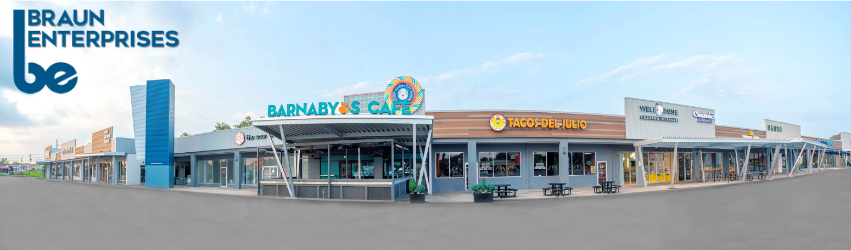
At Braun Enterprises we are driven by character and inspired by community, focusing on the thoughtful acquisition, redevelopment, and repositioning of commercial properties that strengthen key neighborhood corridors throughout Texas. Our hands-on, long-term approach supports local businesses and elevates the quality of communities, including the work we’ve done in the Heights and the Long Point corridor. These projects reflect our commitment to creating lasting value for tenants and the neighborhoods we serve through disciplined execution and community-focused development.
For more information visit https://braunenterprises.com/.