
Infinity Insights - Volume 16, Volume 1
MONTHLY UPDATE - JANUARY 2026 EDITION
NATURAL GAS
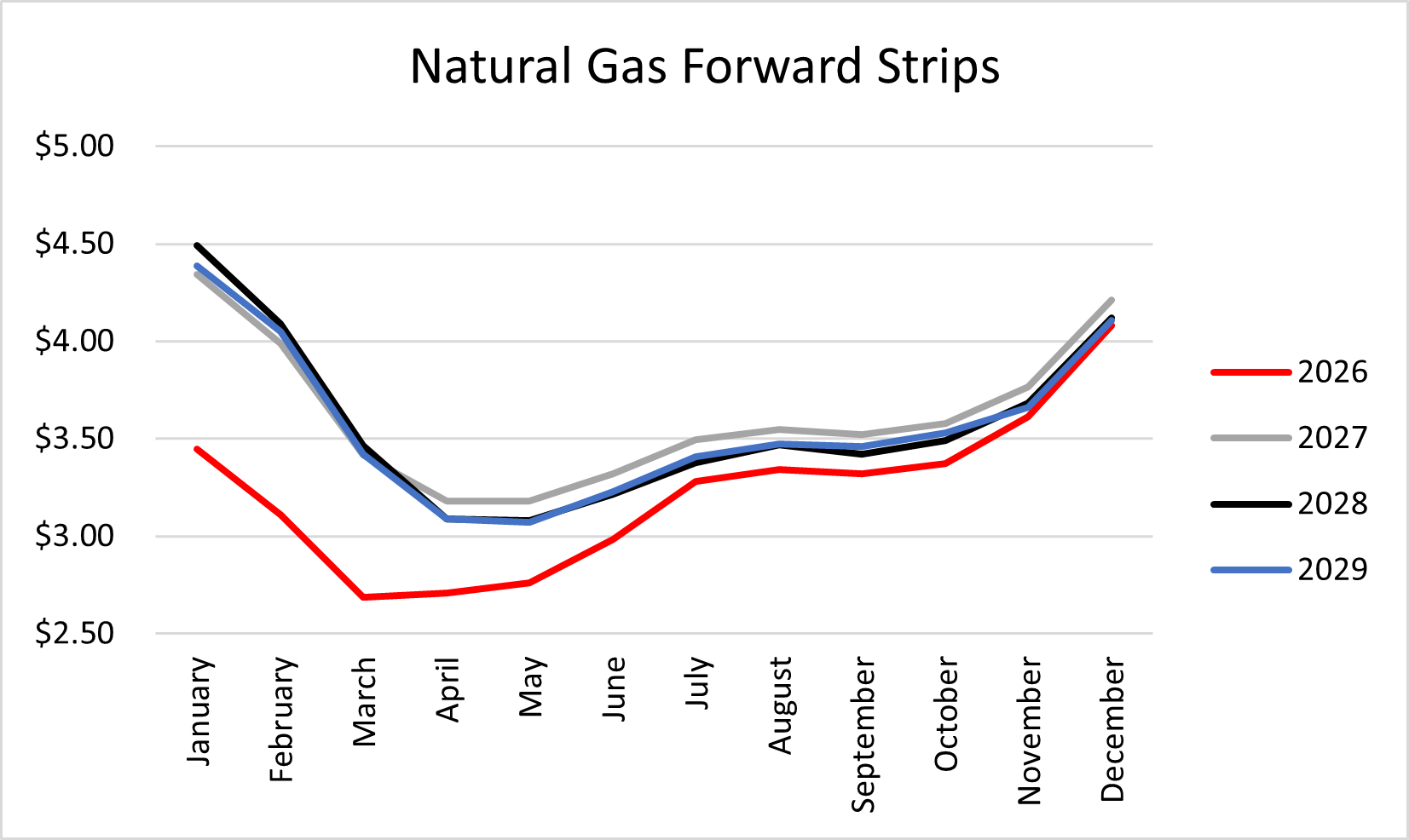
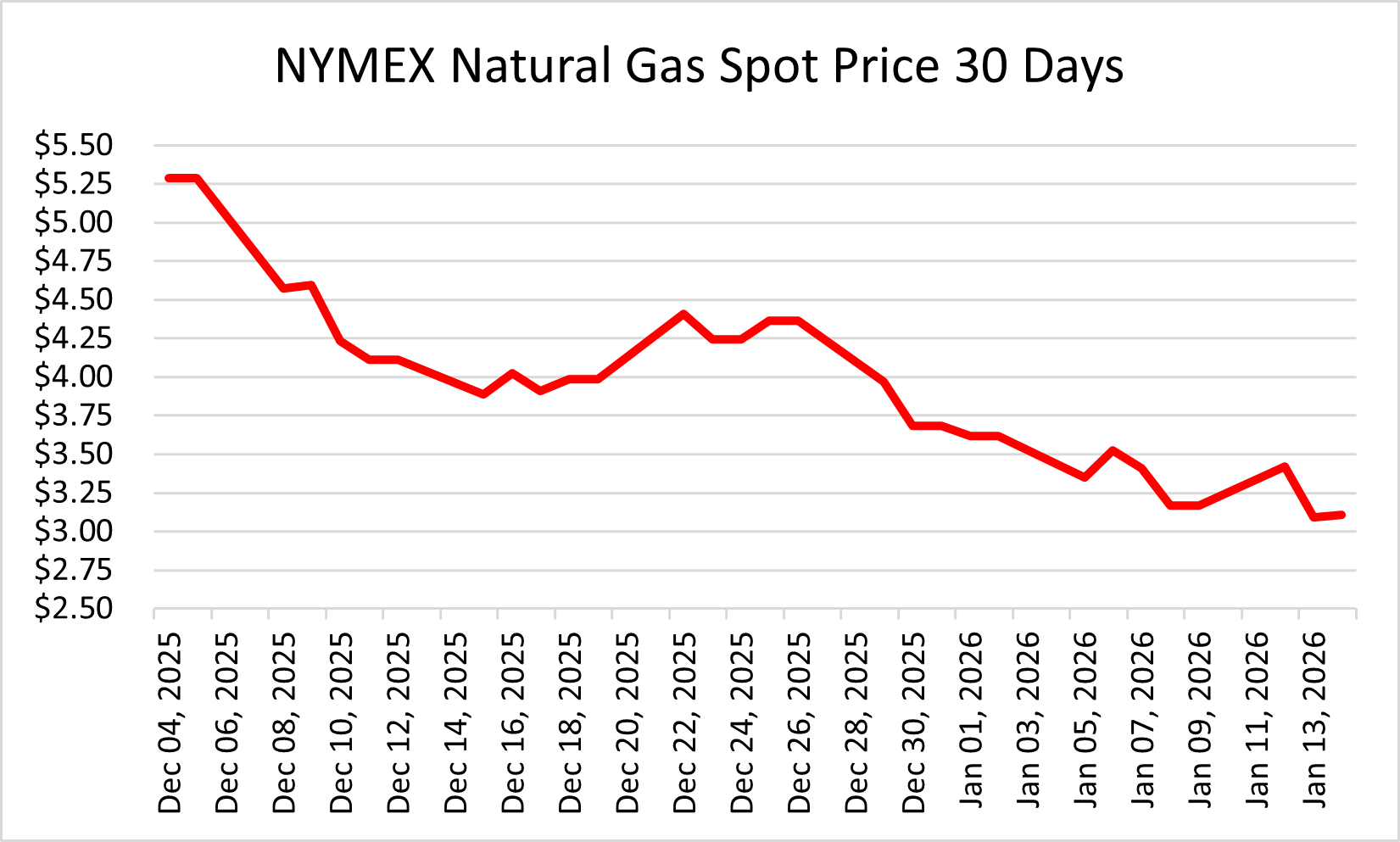
Spot NYMEX Natural Gas started rallying at the end of November and continued climbing, hitting a high of $5.50 on December 4th. Spot jumped considerably after the November contract expired November 24th, when prompt rolled into December. Since the early winter rally peaked December 4th essentially all gains have since been erased.
The sudden rally then sell-off is attributed to cold weather forecasts that were then revised warmer as well as speculation and profit-taking.
The latest price action has more so impacted the front of the curve. Since our last publication the ’26 strip is down 21%, the ’27 strip is down 12% and the ‘28 strip is down 6%.
Natural gas production continues to increase, currently standing at 109.7 Bcf/day. Comparatively, production this time last year was 102.8 Bcf/day. Natural gas storage is in a comfortable position, 1% above last year’s mark and 3% above the 5-yr average. December saw some elevated heating demand with heating degree days coming in 6% above the 10-yr history. Aside from some heating demand, the main driver for natural gas demand has been LNG feedgas. According to the EIA, LNG feedgas is flowing at 18.7 Bcf/day, a 25% increases year-over-year. The EIA is forecasting LNG feedgas demand to continue growing at 9% and 11% in 2026 and 2027, respectively.
EIA’s Short-Term Energy Outlook is forecasting natural gas to average just below $3.50/MMBtu in 2026 and $4.60/MMBtu through 2027. EIA’s forecast is based on demand outgrowing production, citing increased demand for power generation and expanding LNG terminals, providing upward pressure for 2027 pricing.
Spot natural gas has support at $3.00 with resistance at $3.60.
Balance year 2026 finds support at $2.68 with resistance at $4.08. Calendar year 2027 has support at $3.18 with resistance at $4.34. Calendar year 2028 has support at $3.08 with resistance at $4.49 - considerable losses across the board.
Global natural gas prices ($/MMBtu):
Henry Hub (USA): $3.60↓
NBP (UK): $11.06↑
TTF (Dutch) $9.72↓
JKM (Japan/Korea) $9.61↓
Weather
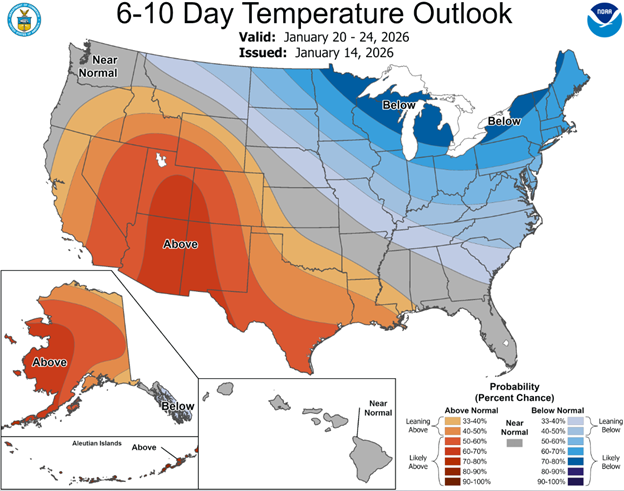
The 6-10 Day and 8-14 Day Temperature Outlook show similar patterns with most of the country above normal temperatures but with the population dense northeast and Great Lakes regions bracing for unseasonably cold weather.
PJM Capacity Auction Results
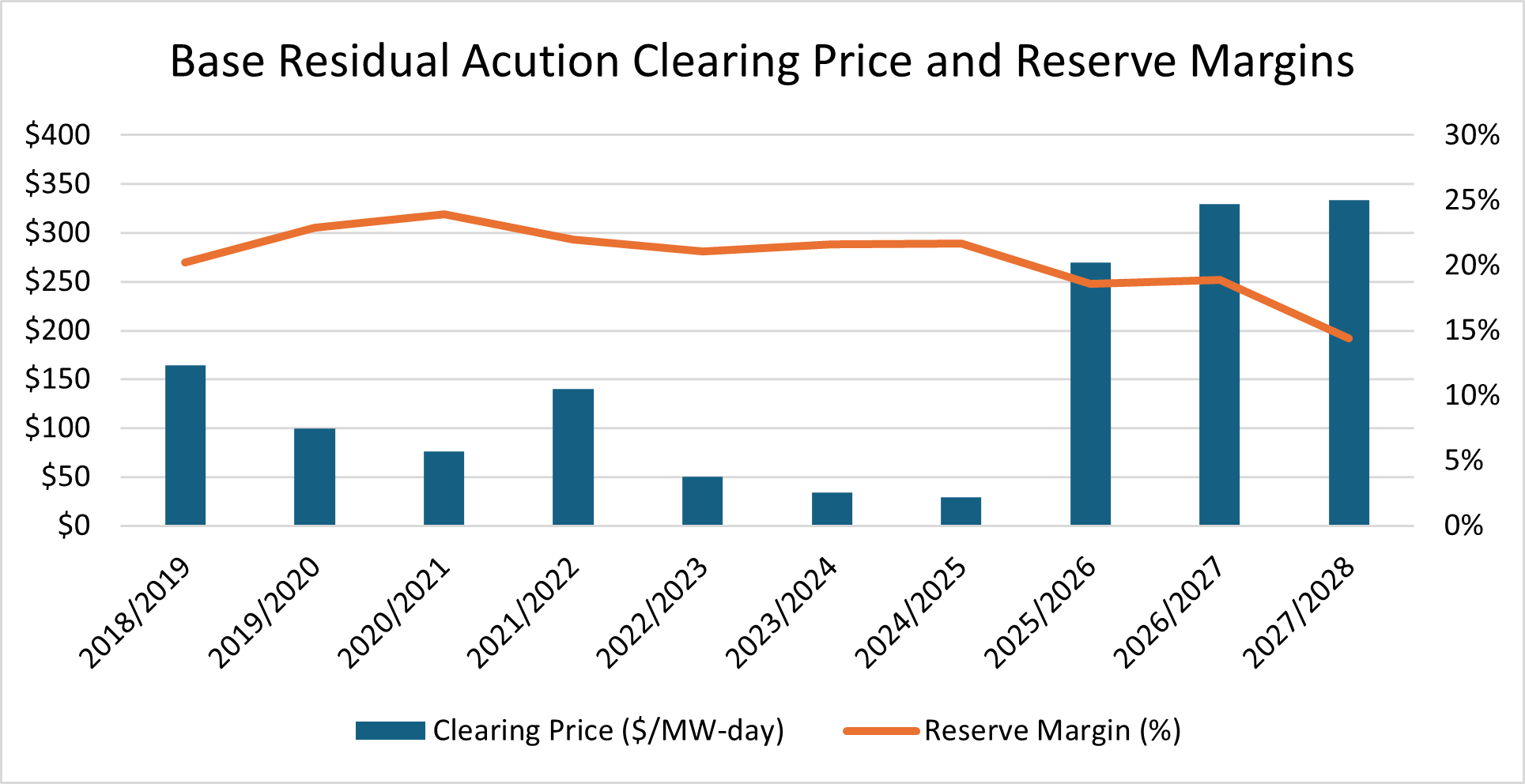
December 17 PJM published its 2027/2028 Base Residual Action (BRA) results. The auction results settled at the ISO’s pricing cap, a record breaking $333.44/MW-day - a 1.3% increase from the most recent auction results for deliveries 2026/2027. The auction was expected to come in high, right around the pricing cap, as it has done since the pricing collar rule was introduced.
Interestingly, the procured reserve margin has fallen to the lowest levels we’ve seen. PJM’s reserve margin target is usually 20%, this year’s auction secured 14.4% margin. The decrease in reserve margins is attributed to retirement of coal and older natural gas power plants exceeding the growth of new generation, all in an environment of surging demand. PJM Winter Peak 2026 is forecasted to exceed the prior year’s peak by 3% driven by growth in EV’s, manufacturing, and datacenters.
The BRA establishes the capacity clearing price ($/MW-day) for a given delivery year (e.g., June 1–May 31), which compensates generators for keeping capacity available. This price flows downstream to load-serving entities (LSEs, like utilities or energy suppliers), who recover costs from customers via capacity charges on bills. For commercial/industrial facilities, these are tied to 5 Coincident Peak (5CP) periods—the five highest system-wide demand hours in the prior summer (typically July–August, 2–6 p.m. ET). The 5CP method allocates costs based on a facility's Peak Load Contribution (PLC), ensuring users pay proportionally to their peak usage impact.
For the sake of simplicity, let’s assume a 50,000 square foot office building’s peak demand on the 5CP days averaged, or Peak Load Contribution (PLC) of 200kW. With a clearing price of $333.44/MW-day, we take the 200kW PLC, adjust it to .2MW and multiply this by the clearing price; .2 x $333.44 = $66.69. This is the daily amount charged to the customer for the delivery period, June 1 thru May 31. In this instance the annual cost would be $24,342. Depending on the utility, these charges show up as “Capacity Charge,” “Reliability Cost,” or “5CP Adjustment”. The pricing is designed to be punitive to the customer, incentivizing the end user to curtail when the grid is in a state of scarcity.
Our take: As the grid evolves from an antiquated analog system to a dynamic smart system, we see a 20% margin target as unnecessary. With improvements in forecasting demand, and a more dispatchable generation mix, we believe PJM will manage with a 14.4% margin and PJM should consider re-evaluating its reserve margin target.
Meta/Vistra Power Purchase Agreement
Meta has entered a 20-yr 2,100 MW power purchase agreement with Vistra. The deal includes generation from Vistra’s Davis-Besse and Perry Ohio power plants and Pennsylvania’s Beaver Valley power plant. In early 2018 FirstEnergy, who owned the Davis-Besse and Perry power plants had planned on retiring these facilities. Only after Ohio passed HB 6 in mid-2019, which provided about $150 million in annual subsidies for plant operation, did FirstEnergy rescind its deactivation notices. With the latest power purchase agreement Vistra is pursuing license extensions for the Perry plant through 2046.
Under the recently formed agreement, Meta’s purchasing will begin in late 2026. Perry Nuclear Power Plant has a nameplate capacity of 1,268 MW, Davis-Besse Nuclear Power Station’s nameplate capacity is 895 MW, and Beaver Valley Power Station’s nameplate capacity is 1,872 MW. Vistra has also committed to providing an additional 433 MW through efficiencies, or as known in the industry “uprates”. The uprates will roll out gradually between late 2026 and 2034 with the lion’s share of the gains occurring in the early 2030’s.
The details of the deal have not been announced but a Morgan Stanley analyst has suggested the pricing of the deal probably fell within $85 to $90 per MWh. This is a considerable premium for the JPM market where energy-only rates can be secured in the $40 to $70 per MWh range. This is either a carbon-free marketing play or these tech majors see tremendous value in consistent, uninterrupted power supply.
The Meta/Vistra deal is only the latest power purchase agreement deals inked with big tech companies rushing to secure power contracts. Meta itself has entered various deals including nuclear, solar and wind for a total of 6,600 MW. Google (Alphabet) has secured 1,300 MW of supply, Amazon has secured 4,480 MW of supply and leading the pack, Microsoft, has secured 11,581 MW of supply.
SoCalGas Price Adjustment
The California PUC has allowed a rate increase for SoCalGas customers effective December 1, 2025. These rates are based on the utility’s cost to procure natural gas, the commodity cost, and passed on to the rate payer. These charges appear on gas invoices as “Gas Commodity” or “Core Gas Cost” line items.
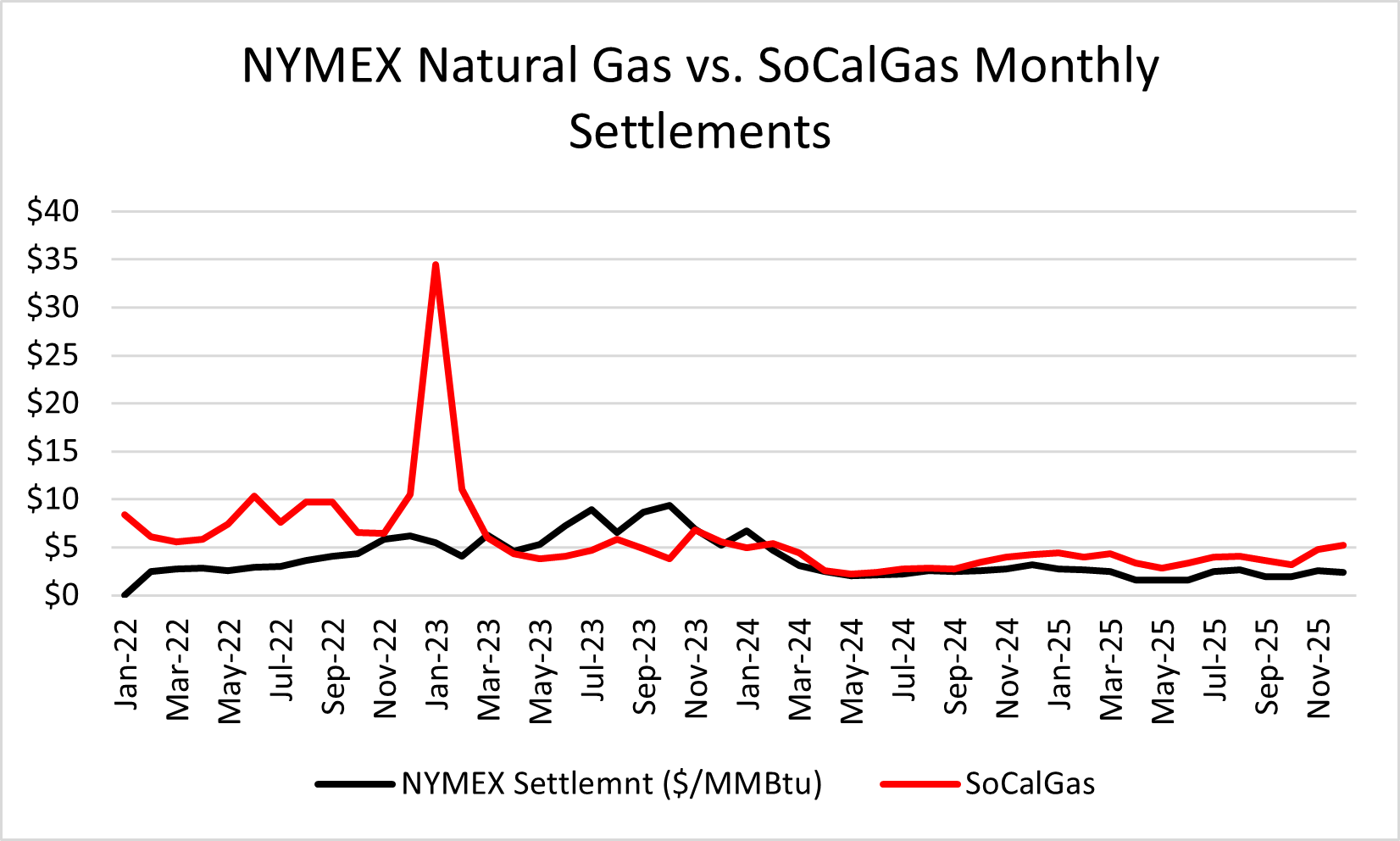
The most recent adjustment changed rates from $.47869/Therm to $.52262/Therm, yielding a 9% increase. It is not unusual to see double digit percentage increases or reduction month-to-month as a SoCalGas customer. In order to simplify this, the data below is January 2022 forward comparing the NYMEX natural gas monthly settlement with SoCalGas monthly charges in $/MMBtu. We can see some correlation in the two commodity settlement prices, but the disparity is clear. For instance, SoCalGas’ January 2023 settlement of $34.49/MMBtu is heavily disconnected to the tame NYMEX settlement of $4.71/MMBtu. The $34.49/MMBtu settlement represented a 227% commodity cost increase over the previous month.
Pricing volatility is a major hurdle when dealing with utilities. At Infinity Power Partners this is one of our specialties. If a utility allows competitive suppliers, which SoCalGas does, there a whole slew of solutions to manage pricing risk for your assets. For instance, pricing can be tied to a citygate or fixed future hedges can be put in place. Please reach out to one of our team members if you would like to know more about managing your commodity risks.
California Electric and Natural Gas Pricing
PG&E, the utility provider for northern California, has announced a reduction in customer bills starting January 1, 2026. A typical single family home customer can expect year-over-year savings of about $7 per billing period for electricity and $1 per billing period for natural gas services. PG&E officials cite a decrease in generation costs as a reason for the reduction. California has seen massive growth in solar and battery deployment, which have no cost of fuel.
On the regulatory side, PG&E had requested the California Public Utilities Commission (CPUC) increase their potential profits through customer bills from 10.28% to 11.3%, a 1.02% increase. CPUC rejected this request and reduced PG&E’s potential profit from customer bills to 9.98%, a .3% reduction.
In March 2026 PG&E will introduce a rate adjustment which will eliminate the temporary Wildfire Hardening Fixed Recovery Charge which began in November 2021 as part of PG&E’s 2019 bankruptcy agreement.
Surprisingly good news for California where costs for power and natural gas usually trend in the opposite direction.
Market News
Q3 GDP growth came in strong with annualized growth at 4.3%. Unemployment remains flat at 4.4%. The US 10 yr treasury remains range bound at 4.16%. December 2025 Consumer Price Index came in a little hot at 2.7% year-over-year and markets are expecting no change in the Fed Fund Rate in January, remaining at 3.50-3.75%. The equity market closed out 2025 with a 17.9% gain in the SP500 over the year, much of that coming from big tech. The geopolitical environment is heating up again with unrest in Iran and the removal of Venezuelan president Nicola Maduro. These are two extremely mineral rich nations which could have resounding impacts on the global energy market. We are closely watching developments on both fronts.
Partner Spotlight - Gatby
Gatby is a technology-driven energy platform focused on simplifying electricity and natural gas decisions for residents and property operators alike. Partnering with multifamily communities nationwide, Gatby helps streamline utility enrollment and management while improving the overall resident experience. Today, Gatby supports more than 350,000 multifamily units across 40+ clients, earning strong customer trust with 5.0 stars across 136 Google reviews and 4.8 stars across 802 Trustpilot reviews.
While Gatby continues to scale nationally, the company remains deeply committed to giving back to the communities it serves, with a focus on creating meaningful, tangible benefits for residents.
Putting Residents First Through Community Giving
At the heart of Gatby’s community efforts is a simple belief: access to essential utilities should be easier, more transparent, and more supportive of everyday life. One of Gatby’s most impactful initiatives is its Holiday Electricity Giveaway, where the company covers a resident’s electricity costs for an entire year — up to $1,500 in savings — helping relieve financial pressure during the most demanding time of year.
Beyond that, Gatby actively engages residents through ongoing social giveaways designed to build connections. Through its social media channels, Gatby regularly gives away experiences such as Toyota Center box seats to Houston Rockets games, concert tickets including Tate McRae, and other local events.
Gatby also works closely with on-site leasing teams to sponsor and support resident events at partnered properties, helping create memorable experiences that bring neighbors together. Whether it’s contributing to community gatherings, resident appreciation events, or on-site activations, Gatby views these partnerships as a meaningful way to give back directly to the people and places it serves.
As Gatby continues to grow, its commitment to community remains a core part of its mission, finding new ways to deliver value, support residents, and make everyday living just a little easier.
To learn more, visit https://www.gatby.com.